
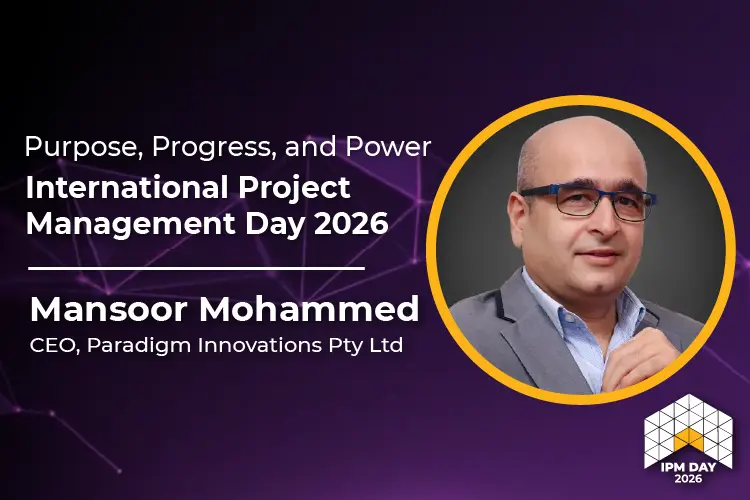
Mansoor Mohammed
CEO
Paradigm Innovations Pty Ltd
In an epoch defined by volatility, uncertainty, complexity, and ambiguity (VUCA), organisations are under increasing pressure to deliver rapid value while maintaining robust governance, accountability, and compliance. Traditional governance models, rooted in bureaucratic control, emphasise predictability, standardisation, and risk minimisation. In contrast, Agile approaches prioritise adaptability, speed, customer-centricity, and continuous learning. This has created a persistent paradox: how can organisations simultaneously maintain control while enabling agility?
This research study addresses the fundamental tension through the lens of governance ambidexterity, proposing a novel framework for integrating Agile leadership and Agile Governance practices.
Drawing on the researcher’s doctoral study on Agile Project Governance, this research study conceptualises governance ambidexterity as the organisational capability to balance and integrate exploratory (adaptive, flexible) and exploitative (structured, control-oriented) governance mechanisms.
Grounded in the theoretical foundations of Complex Adaptive Systems and organisational ambidexterity, the research study adopts a mixed-methods approach. Qualitative and Quantitative data were collected through 40 semi-structured interviews, 3 rounds of Focus Groups using the World Café style in the Project Management Day of Knowledge, conducted with PMI Sydney Chapter and the University of Sydney.
Furthermore, 200 survey data points complemented by quantitative analysis were gathered from experienced practitioners and leaders across industries, using Likert-scale surveys and fuzzy-set Qualitative Comparative Analysis (fsQCA).
The Gioia methodology was employed to develop first-order concepts, second-order themes, and aggregate dimensions, enabling a robust and inductive theory-building process.
The research study findings reveal that the paradox between control and agility is not a trade-off but a dynamic tension that can be effectively managed through deliberate governance design. Key dimensions influencing governance ambidexterity include strategic alignment, leadership mindset, organisational culture, environmental uncertainty, empowerment structures, and adaptive governance mechanisms.
The research study identifies that high-performing organisations adopt “both/and” approaches rather than “either/or” thinking, enabling simultaneous stability and flexibility. Leadership plays a critical role in fostering psychological safety, empowering teams, and enabling decentralised decision-making while maintaining clear strategic intent and governance boundaries.
The research study further introduces a conceptual framework for Agile Governance Ambidexterity, illustrating how organisations can align strategy, leadership, and governance structures to enable value-driven outcomes. It highlights the importance of redefining governance from a control-centric function to a value-enabling capability. Practical implications include the need for tailored governance models, adaptive decision-making frameworks, and the integration of Agile principles into enterprise governance systems. The research study also underscores the role of governance in scaling Agile practices across portfolios and programs, ensuring coherence without constraining innovation.
This research study contributes to both theory and practice by bridging the gap between traditional governance and Agile methodologies, offering a unified perspective that transcends existing dichotomies. It challenges the prevailing narrative that governance inhibits agility and instead positions governance as a strategic enabler of agility when designed with ambidexterity in mind. For practitioners, it provides actionable insights for designing governance systems that are responsive, resilient, and aligned with organisational goals. For scholars, it advances the discourse on governance in complex adaptive environments, opening avenues for further research on leadership, culture, and governance integration.
Ultimately, “The Governance Revolution” calls for a paradigm shift from rigid control to adaptive governance by empowering organisations to thrive in complexity by breaking the paradox between control and agility.
With over 25 years of international experience spanning government, defence, higher education, and technology sectors, Mansoor specialises in driving strategic transformation initiatives through robust program governance and Agile leadership.
As a certified PgMP, PfMP, PMP, and SAFe SPC, Mansoor has led enterprise PMOs, implemented tailored Predictive (Waterfall) and Adaptive (Agile) frameworks at scale, and built Centres of Excellence that elevate organisational maturity.
Mansoor’s approach integrates strategy, leadership, and execution—ensuring alignment, value realization, and sustainable performance.
Mansoor is passionate about empowering professionals and shaping future leaders by designing and delivering impactful learning programs that bridge theory and practice, enabling teams to navigate complexity and deliver measurable outcomes with confidence.
He has led enterprise transformation initiatives, developed Centres of Excellence, and delivered executive training across Australia, the Middle East, and Asia. He is a certified leader and a respected academic at a University in Australia.
International Institute for Learning
880 3rd Ave, 5th Floor
New York, NY 10022
+1-212-758-0177
+1-800-325-1533
Virtual Learning Support: +1-212-515-5100
Administration/Production: +1-212-515-5074
© 2026 International Institute for Learning. All rights reserved.
| Cookie | Duration | Description |
|---|---|---|
| cookielawinfo-checkbox-advertisement | 1 year | Set by the GDPR Cookie Consent plugin, this cookie is used to record the user consent for the cookies in the "Advertisement" category . |
| cookielawinfo-checkbox-analytics | 11 months | This cookie is set by GDPR Cookie Consent plugin. The cookie is used to store the user consent for the cookies in the category "Analytics". |
| cookielawinfo-checkbox-functional | 11 months | The cookie is set by GDPR cookie consent to record the user consent for the cookies in the category "Functional". |
| cookielawinfo-checkbox-necessary | 11 months | This cookie is set by GDPR Cookie Consent plugin. The cookies is used to store the user consent for the cookies in the category "Necessary". |
| cookielawinfo-checkbox-others | 11 months | This cookie is set by GDPR Cookie Consent plugin. The cookie is used to store the user consent for the cookies in the category "Other. |
| cookielawinfo-checkbox-performance | 11 months | This cookie is set by GDPR Cookie Consent plugin. The cookie is used to store the user consent for the cookies in the category "Performance". |
| PHPSESSID | session | This cookie is native to PHP applications. The cookie is used to store and identify a users' unique session ID for the purpose of managing user session on the website. The cookie is a session cookies and is deleted when all the browser windows are closed. |
| viewed_cookie_policy | 11 months | The cookie is set by the GDPR Cookie Consent plugin and is used to store whether or not user has consented to the use of cookies. It does not store any personal data. |
| Cookie | Duration | Description |
|---|---|---|
| TawkConnectionTime | session | Tawk.to, a live chat functionality, sets this cookie. For improved service, this cookie helps remember users so that previous chats can be linked together. |
| Cookie | Duration | Description |
|---|---|---|
| _ga | 2 years | The _ga cookie, installed by Google Analytics, calculates visitor, session and campaign data and also keeps track of site usage for the site's analytics report. The cookie stores information anonymously and assigns a randomly generated number to recognize unique visitors. |
| _ga_1G48TWVF45 | 2 years | This cookie is installed by Google Analytics. |
| _gcl_au | 3 months | Provided by Google Tag Manager to experiment advertisement efficiency of websites using their services. |
| CONSENT | 2 years | YouTube sets this cookie via embedded youtube-videos and registers anonymous statistical data. |
| vuid | 2 years | Vimeo installs this cookie to collect tracking information by setting a unique ID to embed videos to the website. |
| Cookie | Duration | Description |
|---|---|---|
| test_cookie | 15 minutes | The test_cookie is set by doubleclick.net and is used to determine if the user's browser supports cookies. |
| VISITOR_INFO1_LIVE | 5 months 27 days | A cookie set by YouTube to measure bandwidth that determines whether the user gets the new or old player interface. |
| YSC | session | YSC cookie is set by Youtube and is used to track the views of embedded videos on Youtube pages. |
| yt-remote-connected-devices | never | YouTube sets this cookie to store the video preferences of the user using embedded YouTube video. |
| yt-remote-device-id | never | YouTube sets this cookie to store the video preferences of the user using embedded YouTube video. |
| yt.innertube::nextId | never | This cookie, set by YouTube, registers a unique ID to store data on what videos from YouTube the user has seen. |
| yt.innertube::requests | never | This cookie, set by YouTube, registers a unique ID to store data on what videos from YouTube the user has seen. |
| Cookie | Duration | Description |
|---|---|---|
| JOTFORM_SESSION | 1 month | No description available. |
| pum_alm_first_activity | 1 day | No description available. |
| pum_alm_last_activity | 1 day | No description available. |
| userReferer | 1 month | No description available. |